


In a nation divided over the Iran war, the treatment of immigrants, midterm elections, overflowing gas prices and federal shutdowns, it tooka voyage to outer spacefora little unity.
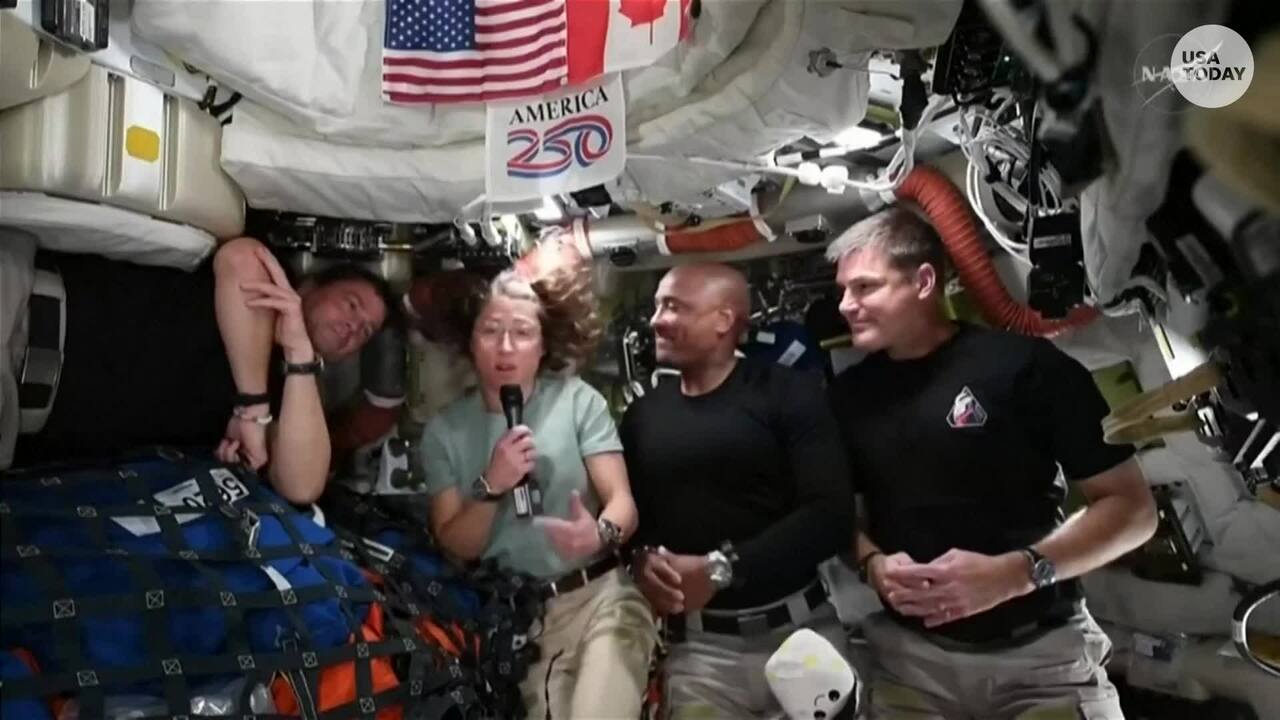
From Florida's Key West to Puget Sound in Washington, America watched and hoped together as the Artemis II astronautslifted off,splashed down, and touched the nation from a quarter million miles away. The wonder of it all helped us forget our differences − at least for a few spins of the Earth.
"Everyone is experiencing it − it's this universal connection that doesn't happen all the time," said Jade Boudreaux, a 34-year-oldaerospace watercolor painterwho traveled from her home in Chicago to witness the Artemis II launch in Florida on April 1 and was riveted ever since to the livestreams from space.
"There is something special inside of you that you have in common with every other person watching," whether it was in person, at one of the manywatch partiesacross the nation or from the comfort of home, Boudreaux told USA TODAY. "It's innate. It's in your heart and it's in your soul. It's very human."
Thefour pioneering astronautson Artemis II also felt the love. Deeply.
"As we continue to unlock the mysteries of the cosmos, I would like to remind you of one of the most important mysteries there on Earth − and that's love," mission pilot Victor Glover said from space. "We're still able to feel your love from Earth. And to all of you down there on Earth, and around the Earth, we love you from the moon."
Since the Orion spacecraft launched from the Kennedy Space Center in Cape Canaveral, people back on the little blue speck called Earth experienced many milestone moments withthe four astronautsriding high on the Artemis II mission.
 Lunar Selfie
Midway through their lunar observation period, the Artemis II crew members, seen here (From left to right: Victor Glover, Jeremy Hansen, Reid Wiseman, and Christina Koch), pause to turn the camera around for a selfie inside the Orion spacecraft.
NASA's Artemis II astronauts are among the first government spacefarers to bring personal smartphones to space. " style="max-width:100%; height:auto; border-radius:6px; margin:10px 0;" loading="lazy" />
 Spaceship Earth
 NASA astronaut and Artemis II mission specialist Christina Koch peers out of one of the Orion spacecraft's main cabin windows, looking back at Earth, as the crew travels towards the Moon. " style="max-width:100%; height:auto; border-radius:6px; margin:10px 0;" loading="lazy" />
 Photographer at Work
Astronaut Jeremy Hansen captures an image through the camera shroud covering window 2 of the Orion spacecraft. The camera shroud, essentially a curtain with a hole for the lens to pass through, is used to prevent light from the cabin from reflecting on the windowpanes. " style="max-width:100%; height:auto; border-radius:6px; margin:10px 0;" loading="lazy" />
 Home, Seen from Orion
NASA astronaut and Artemis II Commander Reid Wiseman peers out of one of the Orion spacecraft's main cabin windows, looking back at Earth, as the crew travels towards the Moon. " style="max-width:100%; height:auto; border-radius:6px; margin:10px 0;" loading="lazy" />
 Eclipse Safety
 First The Artemis II crew – Mission Specialist Christina Koch (top left), Mission Specialist Jeremy Hansen (bottom left), Commander Reid Wiseman (bottom right), and Pilot Victor Glover (top right) – uses eclipse viewers, identical to what NASA produced for the 2023 annular eclipse and 2024 total solar eclipse, to protect their eyes at key moments during the solar eclipse they experienced during their lunar flyby. This was the first use of eclipse glasses at the Moon to safely view a solar eclipse. " style="max-width:100%; height:auto; border-radius:6px; margin:10px 0;" loading="lazy" />
 Final Flyby Preparations
Artemis II Pilot Victor Glover (Left), Commander Reid Wiseman (Center), and Mission Specialist Jeremy Hansen (Right) prepare for their journey around the far side of the Moon by configuring their camera equipment shortly before beginning their lunar flyby observations. " style="max-width:100%; height:auto; border-radius:6px; margin:10px 0;" loading="lazy" />
 Rest Before Lunar Flyby
Artemis II crewmember sleeping bags are illuminated inside the Orion spacecraft on Flight Day 5 of the mission and ahead of the crew's lunar flyby on April 6, 2026. " style="max-width:100%; height:auto; border-radius:6px; margin:10px 0;" loading="lazy" />
Out‑of‑this‑world selfies from the Artemis II astronauts
Lunar SelfieMidway through their lunar observation period, the Artemis II crew members, seen here (From left to right: Victor Glover, Jeremy Hansen, Reid Wiseman, and Christina Koch), pause to turn the camera around for a selfie inside the Orion spacecraft.NASA's Artemis II astronautsare among the first government spacefarers to bring personal smartphones to space.
We gasped when they shared powerful images ofboth the Earthandthe moon. We held our breaths during a 40-minutecommunications blackoutas the crew traveled farther than any other human being has ever gone. Andwe criedwhen the astronauts decided to name a particularly bright moon crater after missionCommander Reid Wiseman's late wife. Then there werethe bathroom troublesand thatfloating jar of Nutella.
Artemis is the story that gave many of us a respite from our differences − although inevitably, it can't settle them all.
As the astronauts get their Earth legs back and NASA scientists work to learn everything they can from the data and observations collected, USA TODAY is looking at what Artemis II has meant to the country and how the mission has laid the groundwork for humanity's return to the surface of the moon in 2028.
Artemis II exploration: 'We needed this'
The Artemis II moon mission is historic for many reasons.
The journey marked the first time a woman − crew specialistChristina Koch− and a Black person − mission pilotVictor Glover− traveled beyond the low Earth orbit. It was also the first time a Canadian astronaut − Jeremy Hansen − has ever flown a moon mission.
The mission sent the four astronautsfarther in spacethan any humans before them, about 250,000 miles away from Earth.
The Artemis II mission tapped into the human need for exploration, the same instincts that brought distant ancestors to North America thousands of years ago, said David Moulton, who serves on the board of the Utah Valley Astronomy Club in Orem, Utah.
“Humans are explorers. We need it,” Moulton told USA TODAY. "We’ve all got a little Neil Armstrong in us.”
Artemis II, he said, offered a sense of unity when war and civil upheaval are disrupting American society, not unlike the atmosphere of the late 1960s and early 1970s, when theApollo missionscaptivated the nation.
 From San Diego to Houston, see cheers and tears as people react to the Artemis II crew's splashdown after a historic 10-day trip to the moon.
Pictured here a boy cheers at a viewing party of the splashdown at the Air and Space Museum in San Diego, California, on April 10, 2026. " style="max-width:100%; height:auto; border-radius:6px; margin:10px 0;" loading="lazy" />


Cheers and tears as Artemis II crew returns from historic moon mission
From San Diego to Houston, see cheers and tears as people react to theArtemis II crew's splashdownafter a historic 10-day trip to the moon.Pictured here a boy cheers at a viewing party of the splashdown at the Air and Space Museum in San Diego, California, on April 10, 2026.
“I remember the national unity that those missions provided our country during a very difficult time in its history,” he said. “We’re enduring another difficult time now with war and civil upheaval. We needed this now like they needed it then.”
Hector Ybe, the 38-year-old founder of a Philadelphia-area astronomy club, was among 50 people at a watch party of the Artemis II launch. It was gratifying, he said, to see people come together across differences of age, race, religion and politics when Americans are otherwise divided.
“It was an amazing moment because everybody forgot about everything happening,” he said. “People were crying, screaming and hugging. This is what we need right now on this planet, things that bring the community together.”

Joseph Darowski, an assistant professor of English at Brigham Young University whose research specialty is pop culture, said media consumption has fractured to such a degree that “it takes a very big story to break through the flood of news.”
Advertisement
The Artemis mission, he said, is a largely apolitical story significant enough to overcome that fragmented environment. His 9-year-old son, he said, was “obsessed with the mission” and constantly watched the live feeds over spring break.
“Where our biggest cultural stories – politics and sports – have a sense of us versus them and winners versus losers, the Artemis mission has a sense of wonder that unifies,” he said. “The Artemis story feels like a breath of fresh air.”
Moments big and small and heartwarming
Over the course of the 10-day Artemis II mission, many moments stood out as cultural touchstones. And unlike the Apollo days, Americans now have social media to express all the feels, create memes and share powerful quotes from the astronauts in real time.
One such moment was when the Artemis II crew said they had decided to name one of the moon's craters after the late wife of missionCommander Reid Wiseman, who was just 44 when his wife Carroll died following a five-year cancer battle in 2020. He became a single dad to the couple's two daughters, Katie and Ellie.
“A number of years ago we started this journey, in our close-knit astronaut family we lost a loved one,” pilot Victor Glover said as Wiseman wiped his tears. The crater, Glover said, is "a bright spot on the moon."
"We would like to call it Carroll," he said as his voice broke.

The emotional moment went viral, with users on social media responding with comments like, "He gave her the moon," and: "Cried watching it live, cried watching it again, cried watching it a third time."
Then there were the lighter moments, like when a jar of Nutella unexpectedly floated through theOrion spacecraftduring a broadcast of thespace mission.
On social media, people werequick to have fun with the moment, with one person joking: "Nutella's marketing team just got the week off." Another wrote: "Nutella has gone where no Nutella has gone before."
And then there were the profound moments that inspired millions. When the astronautsreached the farthest pointhumans have ever been in space, Americans were in awe.
"Such a magical experience," one viewer wrote. "So thankful to be alive to witness this."
Artemis II lays ground for humanity's return to moon surface
The resounding success of the Artemis II mission has helped lay the groundwork forhumanity's return to the moon in 2028and eventualhuman expeditions to Mars.
If 2028 goes as hoped, it will be the first time humans willstep foot back on the moonsince the Apollo 17 mission in 1972. The planned mission will include a moon walk and a series ofscientific experiments, according toNASA.
The ultimate goal is for NASA to spend the next few years using a series of both crewed and uncrewed lunar landings tobuild a $20 billion moon basewhere astronauts could live and work long term. That work is considered a stepping stone for human exploration to Mars.
The Artemis II mission “marks the beginning of a new chapter in our relationship with the moon," Ed Macaulay, a lecturer in physics and data science at Queen Mary University in London, saidin a piece for The Conversationon April 10.
He added: “The experience has rekindled the optimistic spirit of the Apollo era for a new generation."


See Artemis II splashdown after record-breaking trip around the moon
Just after the Artemis II hada flawless splashdownas millions watched with bated breath on Friday evening, NASA Administrator Jared Isaacman was jubilant as he spoke from the deck of USS John P. Murtha, the recovery ship for the Orion spacecraft.
"We are back in the business of sending astronauts back to the moon," he said. And then he promised: "This is just the beginning."
Contributing: Eric Lagatta, USA TODAY, and J.D. Gallop and Mara Ballaby, Florida Today Mara Ballaby
This article originally appeared on USA TODAY:How the Artemis II moon mission brought America together


